Mega-constellations are stacking power-hungry payloads
Direct-to-cell, high-bandwidth, and AI-edge payloads layer onto Starlink- and Kuiper-class buses faster than solar arrays scale. Per-spacecraft power requirements are an order of magnitude higher than they were five years ago.
03
Defence and Earth observation need on-demand power
Imaging, radar, and signals constellations want surge capacity for specific passes — not a permanent power budget. Launching extra arrays for peak moments is the wrong answer when those arrays burn duty cycle the other 95% of the orbit.
Every current answer says: each spacecraft launches its own solar arrays. There's a structurally cheaper way — separate generation from station-keeping, the way ground utilities did a century ago.
Architecture
Two tiers, two specialisations
Generation and station-keeping compete in any single-spacecraft design. We separate them.
// schematic. altitudes, scale, and beam geometry compressed for legibility.
Disposable generators at ~500 km
Each generator is a small platform trailing a long conductive cable. As it moves through Earth's magnetic field, motional EMF along the cable produces usable current — the
Electrodynamic Tether (EDT) effect demonstrated by NASA's TSS-1R
in 1996. The harvested power is beamed up to the collector tier at 35 GHz.
A generator has a useful life of 6–12 months at this altitude before atmospheric drag deorbits it naturally. That's a feature, not a flaw — no on-orbit debris liability, no service mission to recover hardware, and the cost of the platform is amortised over a known, bounded service interval.
Persistent collectors at ~1,500 km
Collectors aggregate power from multiple generators, store it, and deliver it on demand to paying customer satellites. At their higher altitude, drag is negligible — station-keeping needs are modest, and small solar arrays cover house power. The work the collector specialises in is power management, not generation.
The pattern is what made every prior utility cheap: durable infrastructure plus consumable supply. Cell towers plus handsets. Power plants plus fuel. Persistent collectors plus disposable generators. Capex sits on the durable tier; the consumable tier scales independently with demand.
Why this is cheaper
Single-tier architectures — one platform that both generates and persists — pay the full station-keeping bill on every megawatt-hour of harvest hardware launched. Split the two functions, and station-keeping only sits on the durable tier. The generator tier doesn't need to last long, doesn't need precision pointing, and doesn't need a large bus. That's where the cost asymmetry comes from.
Technical credibility
What's proven, what we're building
We're not inventing the physics. Most of what we need has already flown — or been demonstrated in a lab — by NASA, ESA, JAXA, and others. Tap any card to see the receipts. Where the heritage runs out, we say so plainly.
Power from a tether
Long electrical cables in orbit can act like generators. NASA, ESA, and the US Naval Research Lab have flown the idea four times — we're scaling it down so it can be mass-produced.
How we know this works▾
Electrodynamic tethers have been demonstrated in orbit four separate times. We are not inventing the physics — we are productionising it at the right scale.
Sending energy wirelessly with microwaves is a 50-year-old technology. The 35 GHz band we use punches through the atmosphere with very little loss, and works just as cleanly between satellites.
How we know this works▾
Wireless power transmission has been a working technology for fifty years. The path is band selection, antenna scaling, and pointing — not physics.
Once a collector satellite is on station, two well-proven techniques — electric thrusters and the same tether-thrust trick — keep it parked there for years.
How we know this works▾
Both of the techniques a collector needs are mature. Solar-electric propulsion flies on every large LEO commsat today; tether thrust mode has been demonstrated on orbit.
Every spacecraft in this architecture runs ICARUS OS — our flight-computer brain. It's already shipping today as an open-source product, separately from the power system.
How we know this works▾
We've already built the substrate. ICARUS OS coordinates generators, collectors, and customer handshakes under hardware-level fault isolation — and it's an open-source kernel shipping today.
Most of the technology is mature. There are two specific problems nobody has solved at the size we need — here they are, and here's how we retire each one on the ground before any flight hardware is committed.
Read the two risks in detail▾
Tether deployment reliability at small scale.
Past flight demonstrations were either large-platform (TSS) or proof-of-concept (TEPCE, PMG). A commercially-disposable generator needs a deployment mechanism that works every time on a small bus. Ground deployers retire this before any flight hardware is committed.
Precision beam pointing from a librating tethered system.
The generator is not a rigid spacecraft — the tether introduces low-frequency libration that the beam-pointing system has to track and reject. Closed-loop pointing is characterised in a vibration-isolated ground rig before the system flies.
// we list these because investor and customer due diligence will list them anyway. the path is to retire each on the ground before flight hardware exists.
Roadmap
From today to operational utility
Four phases, each gated on a technical and a commercial milestone. We publish the journey, not the capital stack.
Phase 12026
Foundations
ICARUS OS commercial launch for CubeSat customers.
Ground demonstrators of the tether-based power generator and the 35 GHz microwave beaming sub-system.
Engineering team scaling up across software, hardware, guidance-and-control, and business development.
1 of 4
Phase 22027–28
First flight
First flight hardware: a tether-based power generator on a shared launch as a hosted payload.
On-orbit demonstration of power generation and downlink.
Closed-loop pointing characterised against in-flight tether dynamics.
2 of 4
Phase 32030–31
First operational power station
First generator and collector on orbit together.
Power delivered to a paying customer under a Power Purchase Agreement (PPA).
Manufacturing partnerships established for the disposable-generator tier.
3 of 4
Phase 42032+
Constellation at scale
Multiple operational power stations on orbit.
Power delivered to a growing customer base under long-term agreements.
The orbital power utility, operational.
4 of 4
// dates are working targets. flight-hardware schedules slip when ground demonstrators reveal what the engineering reviews can't.
ICARUS OS — software substrate
ICARUS Satellite OBC Platform
The architecture above needs a flight-software substrate that can coordinate generators, collectors, and customer handshakes deterministically under hardware-level fault isolation. We built one. We also sell it as a standalone product to CubeSat operators today.
~68 KB flash footprint on Cortex-M7. No Linux required.
CubeSat teams shouldn't need NASA-scale infrastructure to fly reliable missions. A satellite OBC software platform with our own ICARUS OS kernel, CCSDS-compliant telecommand and telemetry, and autonomous fault recovery — in a third of the codebase of cFS.
$
cFS = ~100K LOC + ARM / PowerPC SBC KubOS = full Linux distro on a BeagleBone ICARUS = ~5.6K LOC in ~68 KB of flash
7 fault types, 5 escalation levels. From retry to safe mode — automatically.
FDIR
Hierarchical response: log → retry → restart task → mode SAFE → reset. Faults include deadline miss, watchdog timeout, undervolt, link loss, memory corruption, sensor failure, and SEU. Escalation chains are ground-loadable.
CCSDS TC/TM
Standards-compliant telecommand and telemetry. Binary from origin, not sprintf on the flight CPU.
CCSDS TC/TM
Space Packet Protocol with 6-byte primary header (APID, sequence, payload). Command dispatch for mode transitions, fault clearing, and HK requests. Structured binary events — no flight-side string formatting.
Onboard Sequencer
Time-tagged and conditional command execution. Runs autonomously through contact gaps.
Onboard Sequencer
Scripts are ground-loadable via TBL_SEQ_SCRIPT. The satellite keeps executing science operations even when out of contact — no ground intervention required.
CFDP-Lite
File transfer in ~2K SLOC. Class 1 best-effort and Class 2 NAK-based retransmission.
CFDP-Lite
A subset of full CFDP (~15K SLOC) that still handles the common cases: unacknowledged delivery and NAK-based retransmission with bitmap tracking of missing chunks. Static 4 KB RAM buffer, no filesystem dependency.
Ground-Loadable Tables
5 table types, double-buffered, CRC-validated. Update config from the ground without reflashing.
Ground-Loadable Tables
FDIR rules, scheduler slots, limit watchpoints, sequencer scripts, HK selection. Each table is CRC-validated on upload and atomically swapped via double buffering. Your mission config evolves without touching firmware.
Memory Protection
MPU-based per-task isolation. A misbehaving task can't corrupt flight-critical state.
Memory Protection
Hardware MPU with per-task regions across DTCM, RAM_D2 pools, and kernel state. 71 SVC gates enforce privilege separation. A sensor driver can't accidentally scribble on the mode manager's memory.
Persistent State
Battery-backed BKPRAM survives resets. Warm restart without losing mission context.
Persistent State
64 KB VBAT-backed SRAM with magic word + CRC16 validation. Persists MET, last mode, boot count, per-fault counts, and FDIR restart count. A reset in orbit doesn't mean starting from scratch.
Ground Station
React dashboard + WebSocket bridge. Real-time telemetry, commanding, and file transfer — no COSMOS needed.
Ground Station
Python async WebSocket bridge handles USB CDC to the flight CPU. React dashboard with live telemetry graphs, command dispatch, and CFDP file transfers. Ships with the OBC — no separate integration project.
HW CRC Monitor
Self-testing CRC scanner validates 8 code regions using STM32H7 hardware CRC engine. Faults feed directly into FDIR.
HW CRC Monitor
Background task walks 8 flash regions using the STM32H7's hardware CRC peripheral — no CPU burn. On mismatch, raises FAULT_MEMORY_CORRUPTION straight into the FDIR pipeline. Catches SEU-induced bit flips in .text.
SEU Detection
Single-event upset detection with configurable bit-flip injection for ground testing. Radiation-aware from day one.
SEU Detection
Deterministic LFSR-based bit-flip injector validates the full Checksum → FDIR → safe-mode recovery chain. Same seed produces the same corruption pattern — reproducible radiation testing without a beam facility.
Pro
AI Fault Prediction
On-device inference from exact instruction pointer and program context. Predicts faults before they cascade — not after.
AI Fault Prediction
Lightweight on-device model trained on instruction-pointer traces and program state snapshots. Flags anomalies in the hot path before they trip the FDIR escalation chain. Proactive, not reactive.
Pro
Execution Checkpoint
Resume from exact program context after a fault. Not from boot — from the instruction you left off on.
Execution Checkpoint
Periodic snapshots of CPU registers, stack frames, and task state pinned to BKPRAM. After a transient fault, the task resumes at its last checkpoint instead of restarting from scratch. Hours of orbital science, not minutes of re-init.
How we compare
← swipe →
We read the cFS codebase so you don't have to.
// column shows ICARUS OBC Prime. Orbit ships a subset (see editions table below).
// claims validated against public vendor docs & web sources on 2026-04-13.
Feature
ICARUS OBC Prime
NASA cFS
KubOS
Bright Ascension
ISIS iOBC
Hubris
FreeRTOS DIY
CCSDS TC/TM
TC/TM + PUS-lite, hot-swappable router
Full PUS-C suite
PUS via service
PUS-C compliant
Add-on module
—
—
FDIR
7 fault types × 5 escalation levels
Basic Health & Safety app
—
Hooks for custom logic
Primitives only
—
—
Onboard sequencing
Native time + event sequencer
Via Stored Command app
Via mission services
Native scheduler
Native scheduler
—
—
CFDP file transfer
CFDP-Lite (~2K SLOC)
Full CFDP class 1–4
Full CFDP
Full CFDP
—
—
—
Ground-loadable tables
5 types, double-buffered atomic swap
Standard cFS tables
DB-backed config
Parameter tables
Limited support
—
—
MPU isolation
Per-task hardware MPU
Partial via OSAL
Linux / SELinux
Unclear
—
Per-task hardware MPU
—
Persistent state
BKPRAM + CRC16 verified
Unclear
U-Boot env vars
Unclear
FRAM / SD card
—
—
SEU detection
EDAC + memory scrub
—
—
Hooks for custom
—
—
—
HW CRC monitor
8 regions, HW engine, zero CPU
Software checksum
—
Unclear
—
—
—
Ground station
Included — React + WebSocket
—
Major Tom (paid SaaS)
MCS (commercial add-on)
—
—
—
Deterministic RTOS
Custom hard-RT kernel
OS-dependent
Partial (RT + Linux)
RTOS-backed
FreeRTOS-based
Hard RT (Rust)
Soft RT
DO-178C docs Roadmap
Planned
—
—
—
—
—
—
Target hardware
Cortex-M7 (STM32H7)
ARM / PowerPC
Linux SBCs
MCU + Linux
ARM9 (iOBC)
Cortex-M
Cortex-M
Language
C
C
Rust + Python
C / C++
C
Rust
C
License
OBC: Commercial • Kernel: Apache 2.0
Apache 2.0
Open source
Commercial
Commercial
MPL-2.0
MIT (kernel)
Codebase
~5.6K LOC, ~68 KB flash
~100K+ LOC
Large
Unclear
Unclear
~50K LOC
Varies
Community
New
Large (NASA-led)
Active
Enterprise
Enterprise
Growing
Massive
Flight heritage
Pre-launch
40+ incl. JWST, LRO
Limited public data
50+ deployments
Flown since 2014
No space heritage
CubeSats (varies)
AI fault prediction Roadmap
Planned (PC + reg context)
—
—
—
—
—
—
Execution checkpoint Roadmap
Planned (resume-from-state)
—
—
—
—
—
—
MISRA C compliance Roadmap
Planned
—
—
—
—
—
—
Payload drivers Roadmap
Planned
Library available
Library available
Library available
Library available
—
—
Safety traceability Roadmap
Planned
—
—
—
—
—
—
Two editions
// from orbit to prime. upgrade path built in.
Feature
Orbit
Reach orbit. Stay there.
Mission Critical
Prime
The flight-grade moat.
OS kernel
Core (Apache 2.0)
Reaper (commercial)
CCSDS TC/TM
✓
✓
Sequencer
✓
✓
CFDP-Lite
✓
✓
GL tables Prime
✓
Basic tables; no double-buffered atomic swap
5 types, double-buf
Atomic swap with CRC validation. Update config in orbit. Zero-downtime reconfig.
Persistent state
BKPRAM + CRC16
BKPRAM + CRC16
MPU isolation
Per-task HW MPU
Per-task HW MPU
SEU detection
✓
✓
HW CRC Prime
✓
SW-assisted — slower scan, lower CPU budget
8 regions, HW engine
Hardware-accelerated. Continuous 8-region scan with zero CPU load. Catches SEU bit-flips the moment they happen.
FDIR Prime
Basic (3 levels)
One bad day and you're scrambling on ground
7 types × 5 levels
Hierarchical escalation: retry → isolate → swap → safe → recover. The satellite saves itself while you sleep.
Ground station Prime
CLI
No live dashboard. You build the UI yourself.
React + WebSocket
Real-time telemetry dashboard out of the box. Live plots, alerts, command uplink. Ops starts on day one.
AI fault prediction Prime
—
Faults still surprise you — you react, not predict
On-device inference
Lightweight model trained on instruction-pointer + program context. Catches anomalies before the FDIR chain fires. Predict, not react.
Execution checkpoint Prime
—
Every fault = full reboot. Hours of orbital re-init.
Resume from state
Snapshots of registers, stack frames, and task state pinned to BKPRAM. After a fault, your task resumes from the last instruction — not from boot. Hours of science saved per anomaly.
Support Prime
Email
Async only. No pager for your 3 AM anomaly.
On-call engineer
Dedicated engineer on pager rotation. Real humans answer when your sat starts misbehaving. Mission success is a shared KPI.
Mission integration Prime
—
You own the integration work end-to-end
Full loop
Weekly syncs, flight config reviews, pre-launch readiness checks. We own the integration outcome with you, not just the codebase.
// most RTOSes schedule tasks. ours also catches radiation.
// claims validated against public vendor docs & web sources on 2026-04-13.
Feature
ICARUS Core
ICARUS Reaper
FreeRTOS
Zephyr
RTEMS
Hubris
VxWorks
License
Apache 2.0
Commercial
MIT
Apache 2.0
GPL-2.0 / BSD
MPL-2.0
Commercial
Language
C
C
C
C
C
Rust
C / C++
Target hardware
Cortex-M7
Cortex-M7
Many MCUs
Many archs
18 archs, 200 BSPs
Cortex-M (MPU)
Many
Per-task MPU isolation
✓
yes (extended)
Partial (MPU port)
✓
Partial
yes (required)
✓
Preemptive scheduler
✓
✓
✓
✓
✓
✓
✓
Persistent state (BKPRAM)
✓
✓
—
—
—
—
Via apps
HW CRC integrity scan
✓
✓
—
—
—
—
Via apps
SEU detection
✓
✓
—
—
—
—
Via apps
AI fault prediction
—
Planned
—
—
—
—
—
AI runtime + SDK (bounded WCET)
—
Planned
TFLM (app-level)
TFLM / microTVM module
—
—
TFLite + LEIP
Execution checkpoint
—
Planned
—
—
—
—
—
Kernel footprint
~6 KB ITCM / ~52 KB flash
~8 KB ITCM (est.)
6–12 KB ROM
~30–60 KB
Larger
~10 KB ROM
Larger
Space flight heritage
Pre-launch
Pre-launch
CubeSats
Growing
Mars, TGO, ISS
None
Mars, InSight, Clementine
DO-178C certification
—
Planned
no (SafeRTOS is separate)
—
—
—
DAL A available
Community / ecosystem
New
New
Massive
Large
Medium (space)
Small
Paid enterprise
Price
Free
Per-mission
Free
Free
Free
Free
High ($$$)
// note: cert and heritage go to VxWorks and RTEMS. We don't pretend otherwise.
Our edge is the integration of space-specific fault tooling (HW CRC, SEU, persistent state, AI prediction) in a small Cortex-M kernel — not decades of deep-space missions.
Satellite Mode State Machine
// five modes. no surprises. mostly.
Philosophy
How we think
Determinism
Power systems can't be statistical. Every cycle accounted for in flight software, every beam timed, every handover scheduled. ITCM-resident hot paths and deterministic scheduling under the hood.
Safety
Hardware-level fault isolation across the whole architecture — generator-side, collector-side, customer-side. 5-level fault escalation, hardware CRC monitoring, SEU-tested, MISRA-C on the roadmap. Evidence, not promises.
Long-term
A power utility is a long-term commitment, not a launch event. Ground-loadable configuration. State that survives resets. Hardware sized for known service intervals. Built to outlast each mission contract.
Free mission-design calculators — now with an AI explainer
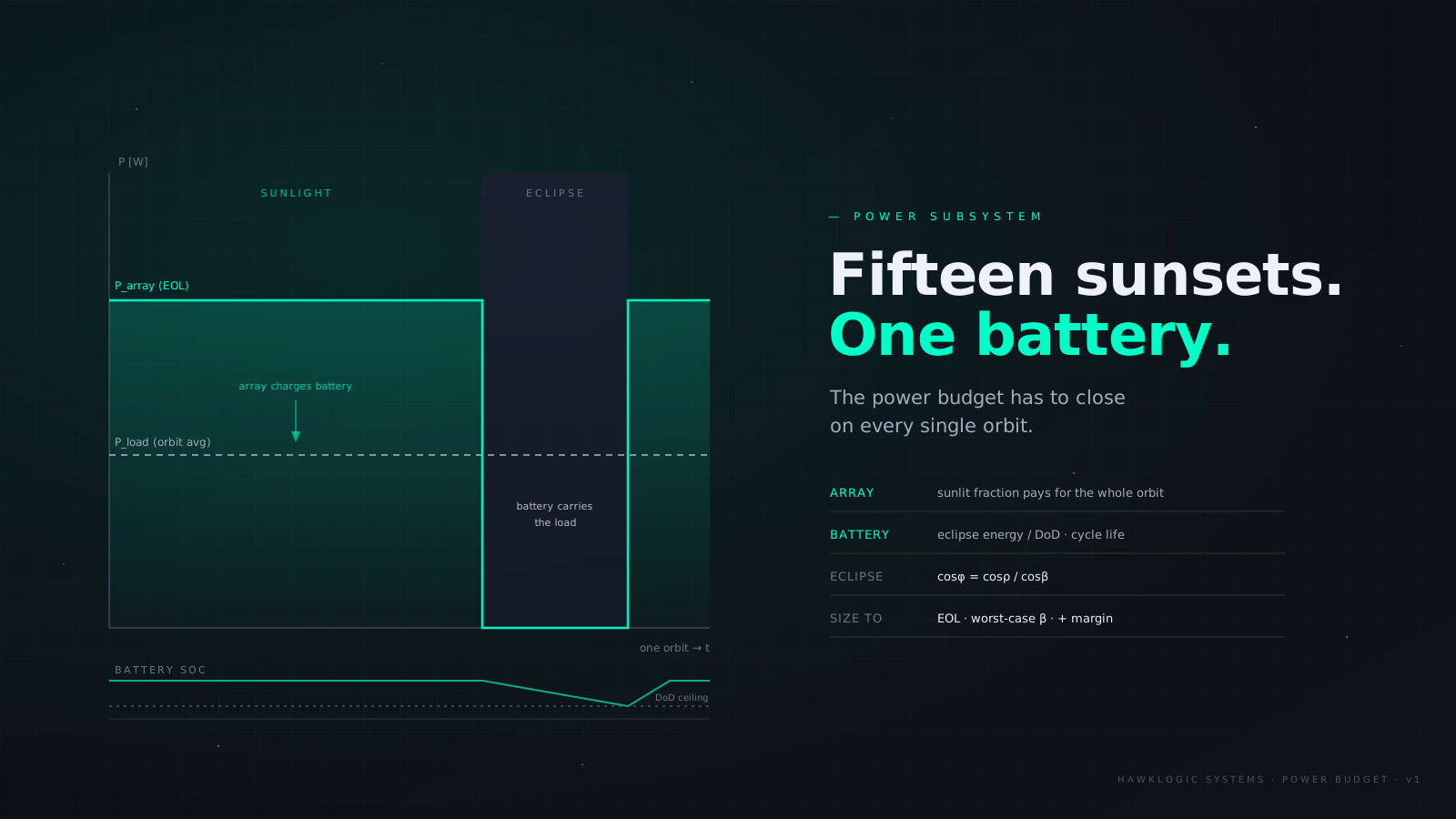
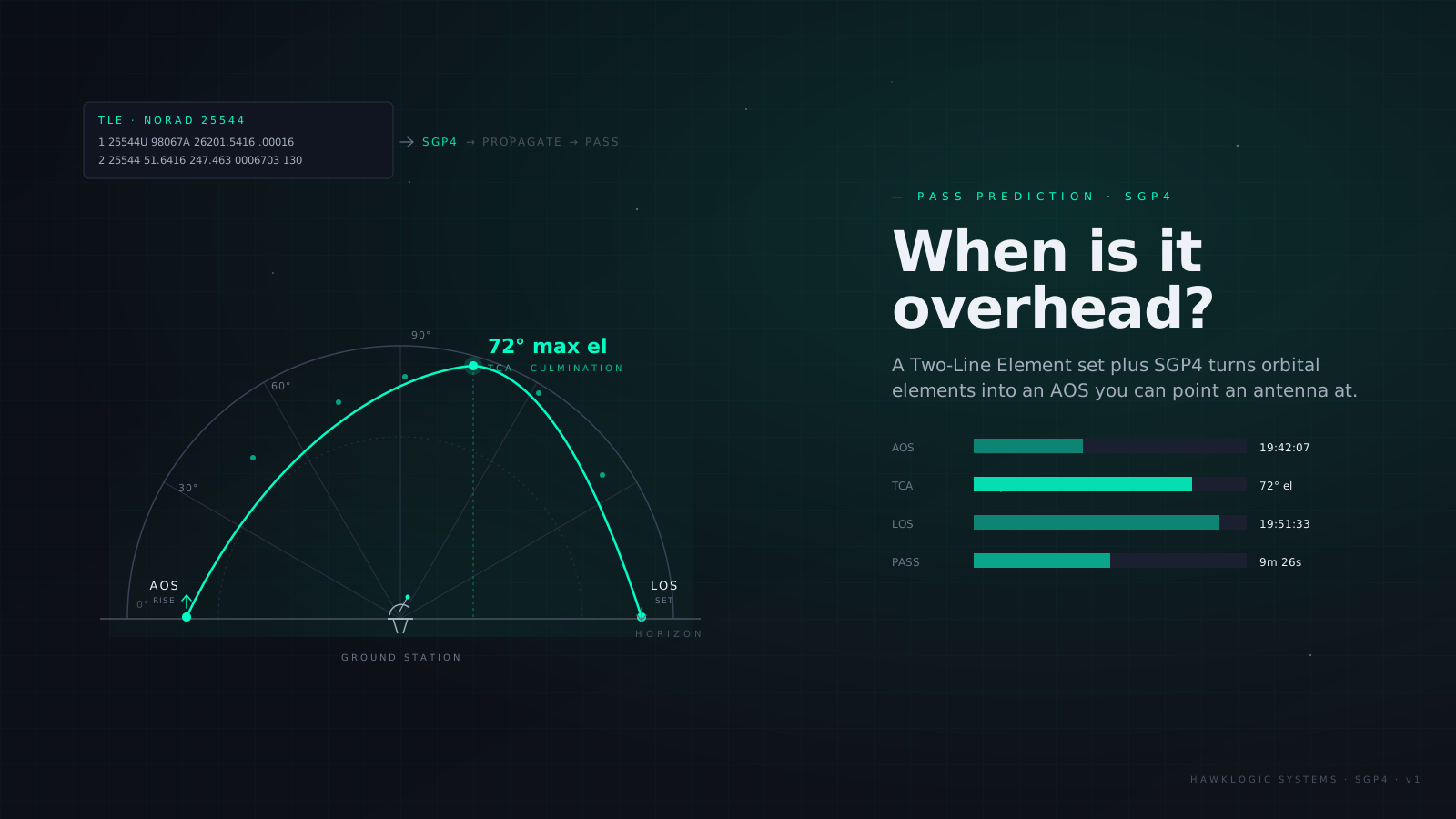
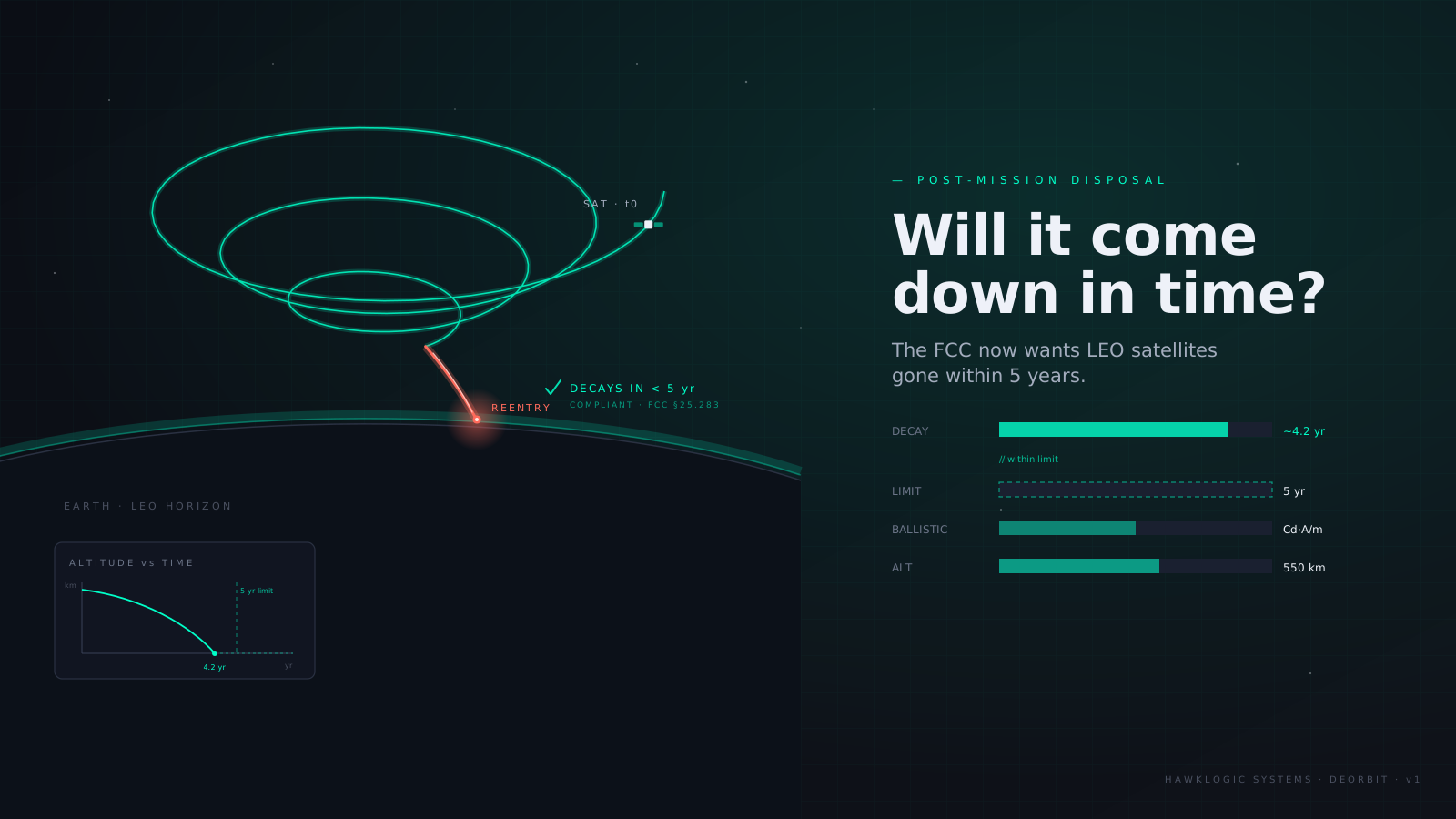
Power budgets, link budgets, drag-decay timelines, tether output. Run the
numbers, then let ENKI break down what they mean for your mission —
flow charts and diagrams included.