The FCC 5-year rule: will your CubeSat come down in time?
Orbital decay physics, ballistic coefficient, solar-cycle sensitivity, the FCC 5-year post-mission disposal rule, ESA Zero Debris, and remediation options.

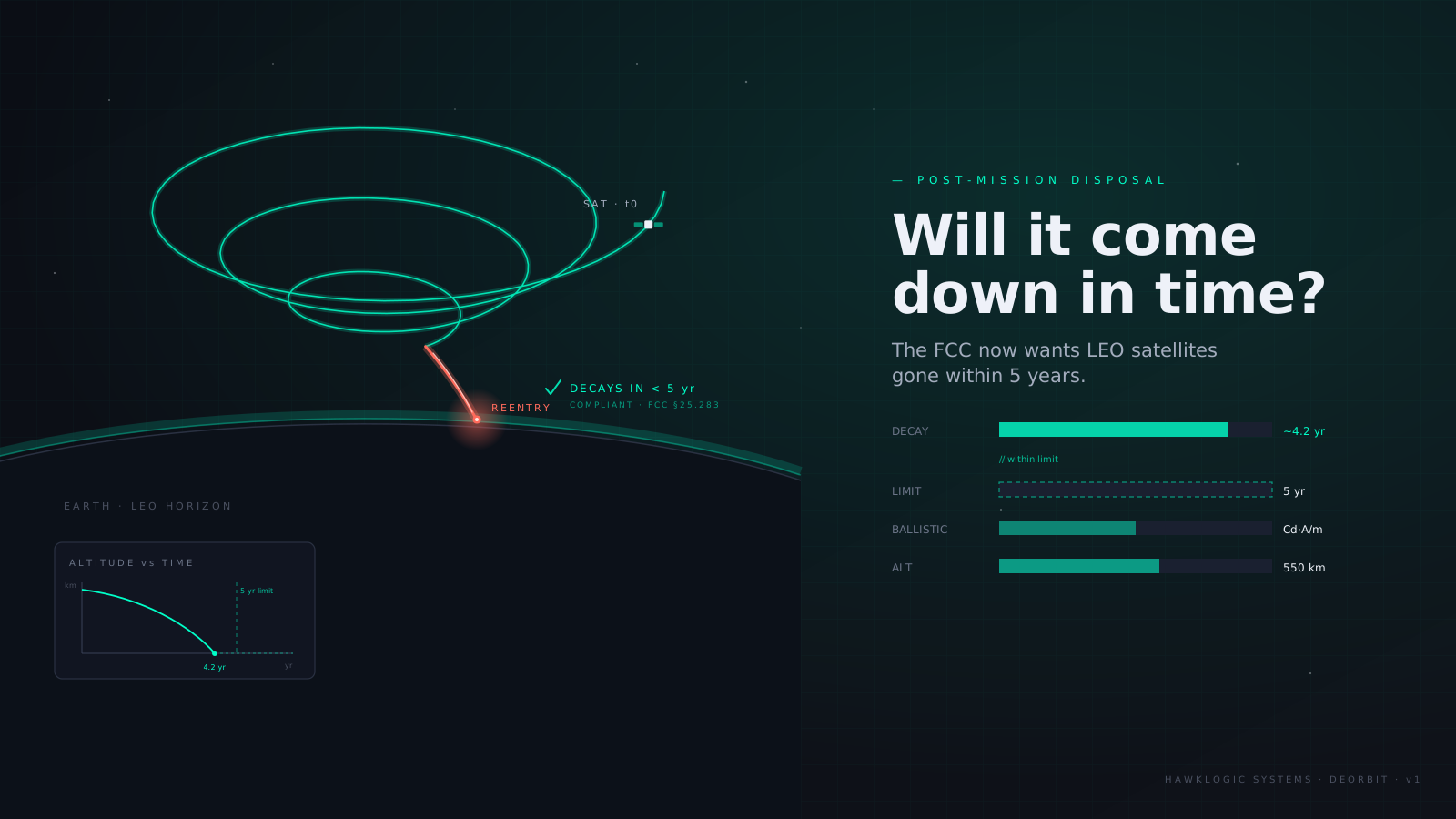
For two decades the answer to “how long can my dead satellite stay up?” was 25 years, and almost nobody checked whether their design actually met it. That era is over. The United States Federal Communications Commission (FCC) now requires Low Earth Orbit (LEO) spacecraft to be disposed of within five years of end of mission, and it is enforcing the requirement at the license-application stage. If your CubeSat’s decay analysis doesn’t close, your application is at risk before you’ve bent metal.
This post covers the physics that determines your orbital lifetime, the regulatory landscape as it stands, and the remediation options when the numbers come out wrong. The lifetime estimates quoted below come from our drag-decay calculator; the regulatory check itself is the deorbit-compliance checker.
The physics: drag, and what controls it
A satellite in LEO flies through the thermosphere, a gas so thin it barely deserves the name, but at 7.6 km/s even a thin gas extracts real energy. The drag force is:
F_drag = ½ · ρ · v² · Cd · Awith ρ the local atmospheric density, v the velocity relative to the atmosphere, Cd the drag coefficient (2.0–2.4 for most spacecraft in free-molecular flow; 2.2 is the standard assumption), and A the projected area in the velocity direction. Drag removes orbital energy, the semi-major axis shrinks, and, counterintuitively, the spacecraft speeds up as it descends, because a lower orbit is a faster orbit. For a near-circular orbit the decay rate is:
da/dt = −√(μ·a) · ρ · (Cd·A / m)The spacecraft-side physics collapses into one number, the ballistic coefficient:
B = m / (Cd · A) [kg/m²]High B (heavy, compact) means the spacecraft punches through the drag and stays up. Low B (light, draggy) means it comes down fast. Orbital lifetime scales approximately linearly with B, which is the lever every remediation strategy pulls. A tumbling 6U CubeSat at 8 kg with a mean projected area around 0.03 m² has B ≈ 121 kg/m², a fairly typical smallsat value. A deployed drag sail can cut that by an order of magnitude, of which more below.
The density problem
Everything else in the lifetime calculation is arithmetic. Density is the hard part, because thermospheric density at a given altitude is not a constant. It is driven by solar Extreme Ultraviolet (EUV) heating, proxied by the F10.7 solar radio flux index, plus geomagnetic activity. Over a solar cycle, density at 500 km swings by roughly an order of magnitude between solar minimum (F10.7 near 70) and a strong solar maximum (F10.7 above 200). The atmosphere literally inflates when the Sun is active.
The consequence: an orbital lifetime is not a number, it’s a distribution. The same 6U at 550 km might decay in 4 years if it rides a solar maximum down, or 10+ if it launches into a deep minimum. Empirical models (NRLMSISE-00, JB2008) capture the density response, but the future F10.7 profile is a forecast, and solar-cycle forecasting has a humbling track record. Serious compliance analyses therefore run at least three cases (a mean solar-activity profile plus optimistic and pessimistic ones) and demonstrate compliance in the unfavourable case, not the mean. A lifetime claim quoted to three significant figures from a single density profile is a tell that the analysis hasn’t been thought about.
Representative lifetimes for our B = 121 kg/m² 6U, mean solar activity, from the drag-decay tool:
| Circular altitude | Approximate lifetime | 5-year rule |
|---|---|---|
| 450 km | ~1–2 yr | comfortable |
| 500 km | ~2–4 yr | passes |
| 550 km | ~5–8 yr | marginal, solar-cycle-dependent |
| 600 km | ~12–20 yr | fails without remediation |
| 700 km | ~50–100+ yr | fails by an order of magnitude |
The cliff between 550 and 600 km is the single most consequential 50 km in smallsat mission design right now. Density falls off roughly exponentially with altitude (scale height 60–80 km in this regime), so lifetime rises exponentially too.
The regulatory landscape
The FCC 5-year rule
In September 2022 the FCC adopted its orbital-debris update (FCC 22-74), replacing the legacy 25-year post-mission disposal (PMD) guideline with a hard requirement: spacecraft ending their mission in or passing through LEO (below 2000 km) must complete disposal as soon as practicable, and no more than 5 years after end of mission. The rule became mandatory for license applications (and US market-access grants for non-US systems) filed on or after September 29, 2024. The two-year grace period is over; every new application is under the rule now.
Three properties of the rule deserve attention:
- It applies at the application stage. You demonstrate compliance in the orbital-debris mitigation plan before license grant. A decay analysis that doesn’t close is a denial or deficiency-letter risk, not a post-mission fine.
- The clock starts at end of mission, not end of life. A 3-year mission at 600 km with a 15-year natural decay is non-compliant even though the hardware works fine. Mission duration plus disposal must fit the profile.
- It reaches non-US operators. Any system seeking US market access through the FCC (which, for communications missions, is most of the commercial market) is in scope regardless of flag.
ESA Zero Debris and everyone else
The European Space Agency (ESA) moved in the same direction, harder. Its 2023 Space Debris Mitigation Requirements also adopt a 5-year post-mission clearance for LEO, add a 90% disposal success probability requirement (your deorbit method must work even in credible failure cases, which pure “we’ll do a burn” plans struggle to demonstrate), and the Zero Debris Charter targets no new debris generation by 2030 for its signatories. The Inter-Agency Space Debris Coordination Committee (IADC) 25-year guideline still exists on paper, but treating it as the design requirement in 2026 is planning for a regulatory environment that no longer exists. National licensing regimes (the UK, France under its Space Operations Act, Japan) are converging on the 5-year figure as well.
The three regimes side by side (scope, effective dates, post-mission lifetime limits, and casualty-risk caps) are tabulated in our FCC 5-year rule vs ESA Zero Debris vs 25-year guideline comparison.
When the numbers don’t close: remediation
Say you need 600 km for revisit or drag-free payload reasons, and the lifetime table above says 15 years. Four options, in rough order of preference.
1. Fly lower
Boring, free, and underrated. If the mission tolerates 525 km, the problem evaporates. Constellation designers have largely internalised this: the migration of commercial constellations to the 500–550 km band is partly a debris-compliance story. Cost: more drag make-up propellant if you need altitude maintenance, and slightly reduced sensor swath.
2. Increase drag area
Lifetime scales with B = m/(Cd·A), so a deployable drag sail attacks the denominator. Add a 1 m² sail to our 8 kg 6U: a flat panel tumbling averages about half its area projected into the velocity vector, so mean area goes from 0.03 m² to roughly 0.53 m², and B drops from 121 to about 7 kg/m², a 17× reduction. The 15-year lifetime at 600 km becomes roughly a year. Sails are light (tens of grams per 0.1 m² class, a few hundred for m²-class), passive after deployment, and don’t require a working propulsion system at end of mission.
The catch is the ESA-style reliability question: a sail that fails to deploy on a dead spacecraft does nothing, so the deployment mechanism’s reliability becomes part of your 90% PMD success argument. Independent deployment triggers (timer plus watchdog, not just ground command) are the standard answer. Also note a subtlety: a sail increases area-time product during descent, which slightly raises collision probability integrated over the (much shorter) remaining lifetime. Regulators have so far accepted the trade; your collision-risk assessment should still model it.
3. Disposal burn
If the spacecraft has propulsion, lower the perigee at end of mission and let drag finish the job from an elliptical disposal orbit. From a 700 km circular orbit, dropping perigee to 300 km costs one retrograde burn:
Δv = v_circular(700 km) − v_apogee(700 × 300 km ellipse)
   = 7504 − 7394 ≈ 110 m/s
At 300 km perigee, each pass through the dense lower thermosphere bleeds energy quickly; residual lifetime is months. Sizing this burn belongs in the delta-v budget on day one, not as an afterthought: 110 m/s is a large allocation for a small spacecraft (see the propellant table in our Hohmann transfer post). The disposal-Δv solver in the deorbit-compliance checker computes the required perigee and burn for your case, including partial-lowering options where a modest burn drops you across the 550 km cliff and drag does the rest.
4. Active or assisted removal
External deorbit services and docking tugs exist and are maturing, but as a planned compliance strategy for a new application they remain the expensive last resort. Regulators currently treat them as supplementary, not as a substitute for a credible primary plan.
Demise: the other half of compliance
Getting down in 5 years is necessary, not sufficient. The re-entry itself must satisfy the casualty-risk requirement: the probability of debris surviving to the ground and injuring someone must be below 1 in 10,000 per re-entry (the shared FCC/NASA/ESA threshold). CubeSat-class spacecraft generally demise completely, with the recurring exceptions of reaction-wheel steel, titanium pressure vessels, and optical payload glass. Run the numbers rather than assuming: our reentry-casualty-risk tool estimates surviving-fragment kinetic energy and the resulting expectation of casualty for your component list.
Where this lands
The compliance workflow, condensed: compute B honestly (tumbling-average area, not minimum), run decay across pessimistic solar activity, check the 5-year clock from end of mission, size remediation if it fails, then verify demise. Every step is deterministic physics plus documented assumptions, which means it is checkable in an afternoon, not a study contract.
We built the deorbit-compliance checker to run exactly that sequence: FCC 5-year, ESA Zero Debris, and legacy 25-year screening with the drag-area and disposal-Δv solvers attached. If you need the paperwork artifact rather than the screening answer, the compliance-report tool assembles the full orbital-debris mitigation analysis from the same inputs. Run it before you file, because the FCC certainly will.
On this page
Read next
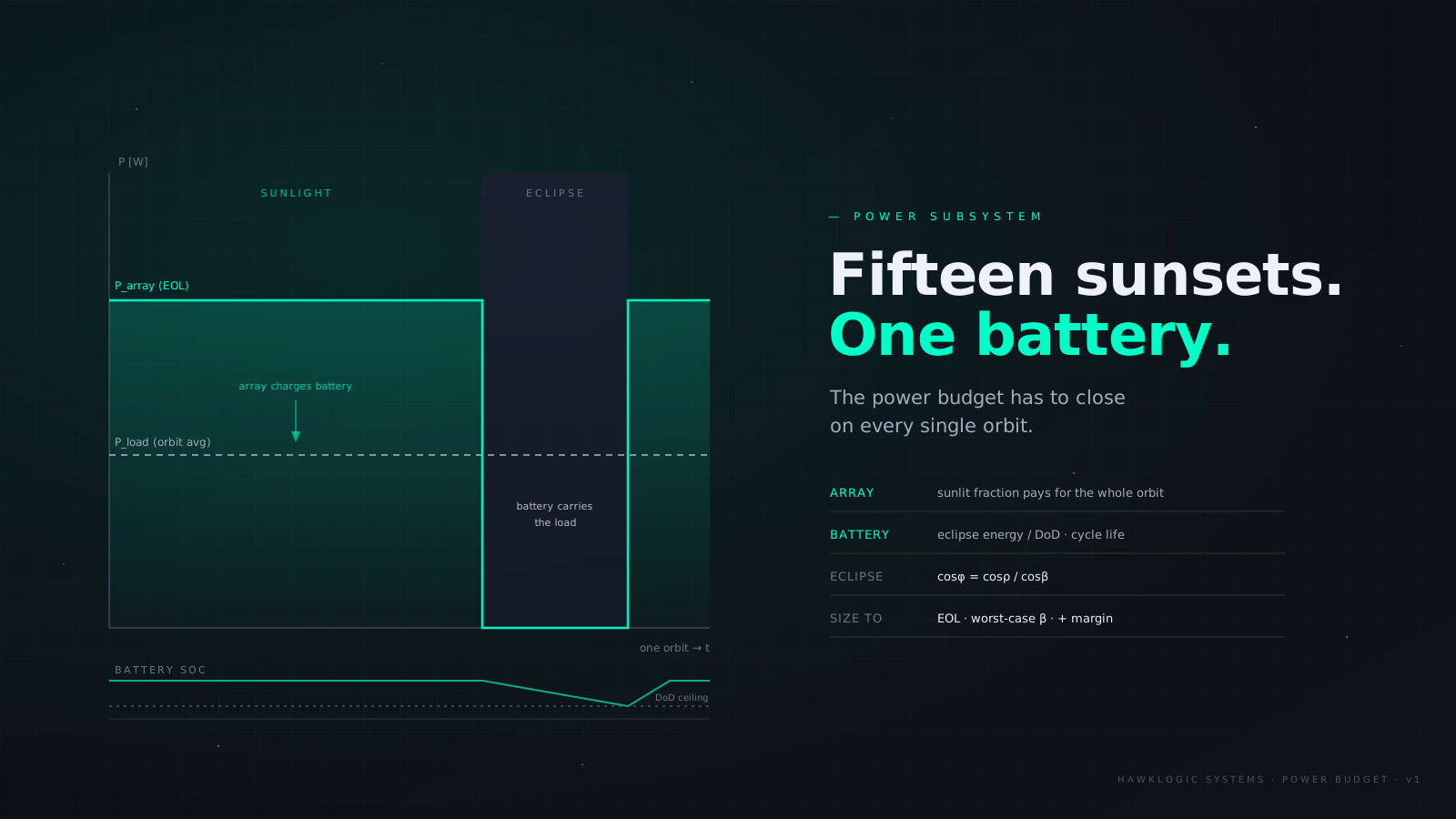
How to build a CubeSat power budget: solar arrays, batteries, eclipse
Load tables by mode, eclipse fraction, solar-array sizing with EOL degradation, battery depth-of-discharge, and a worked 6U example you can reproduce.
9 min read
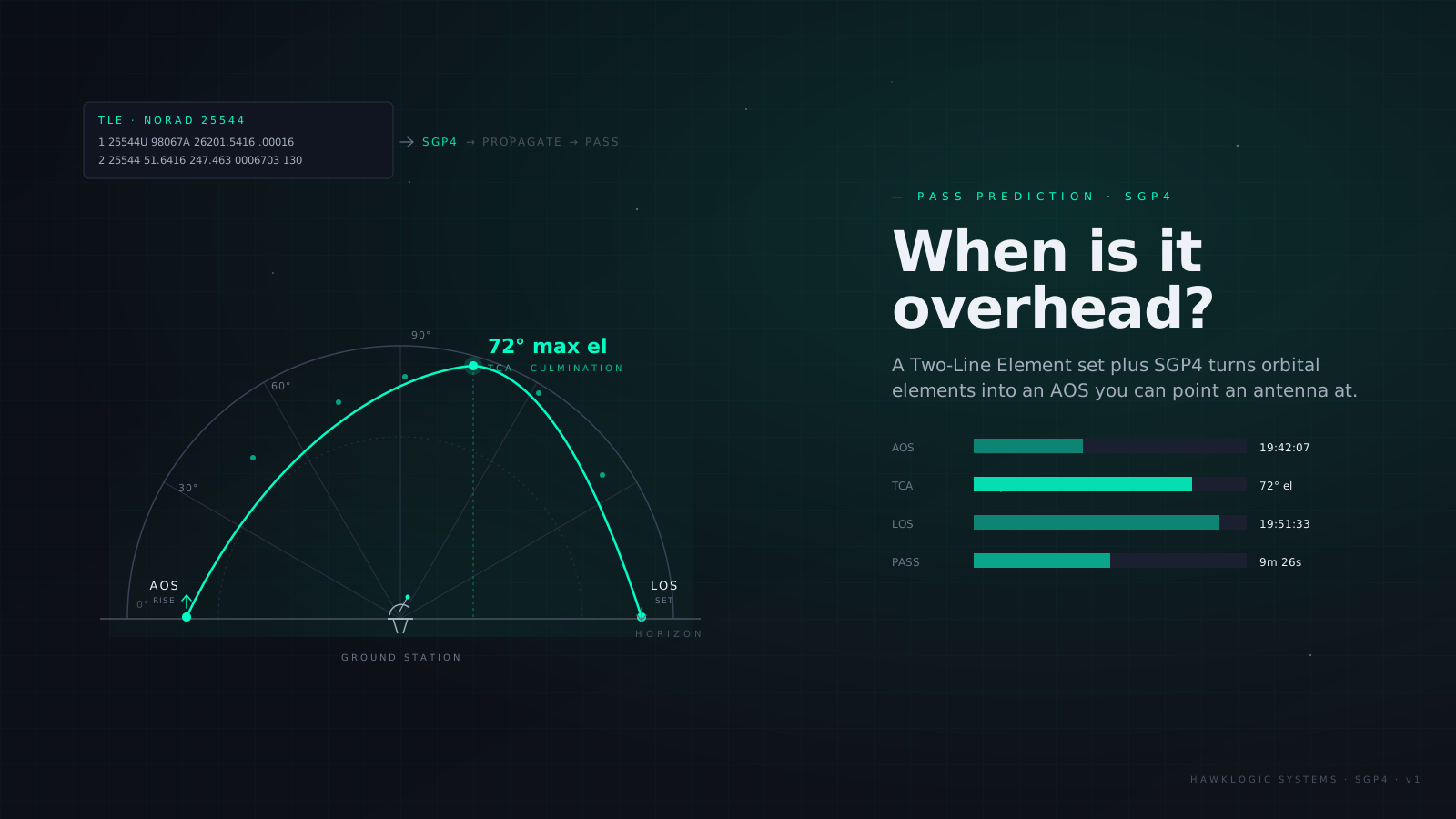
When is my satellite overhead? TLEs, SGP4, and pass prediction
How a Two-Line Element set and the SGP4 propagator become ground-station pass windows (AOS, LOS, elevation masks, max elevation) and why TLE freshness is the whole accuracy story.
7 min read