The delta-v budget: Hohmann transfers and the plane-change formula
The plane-change delta-v formula, delta-v = 2 v sin(delta-i/2), derived: with two-burn Hohmann delta-v from vis-viva, combined maneuvers, and propellant mass via Tsiolkovsky. Worked 400 to 700 km example.

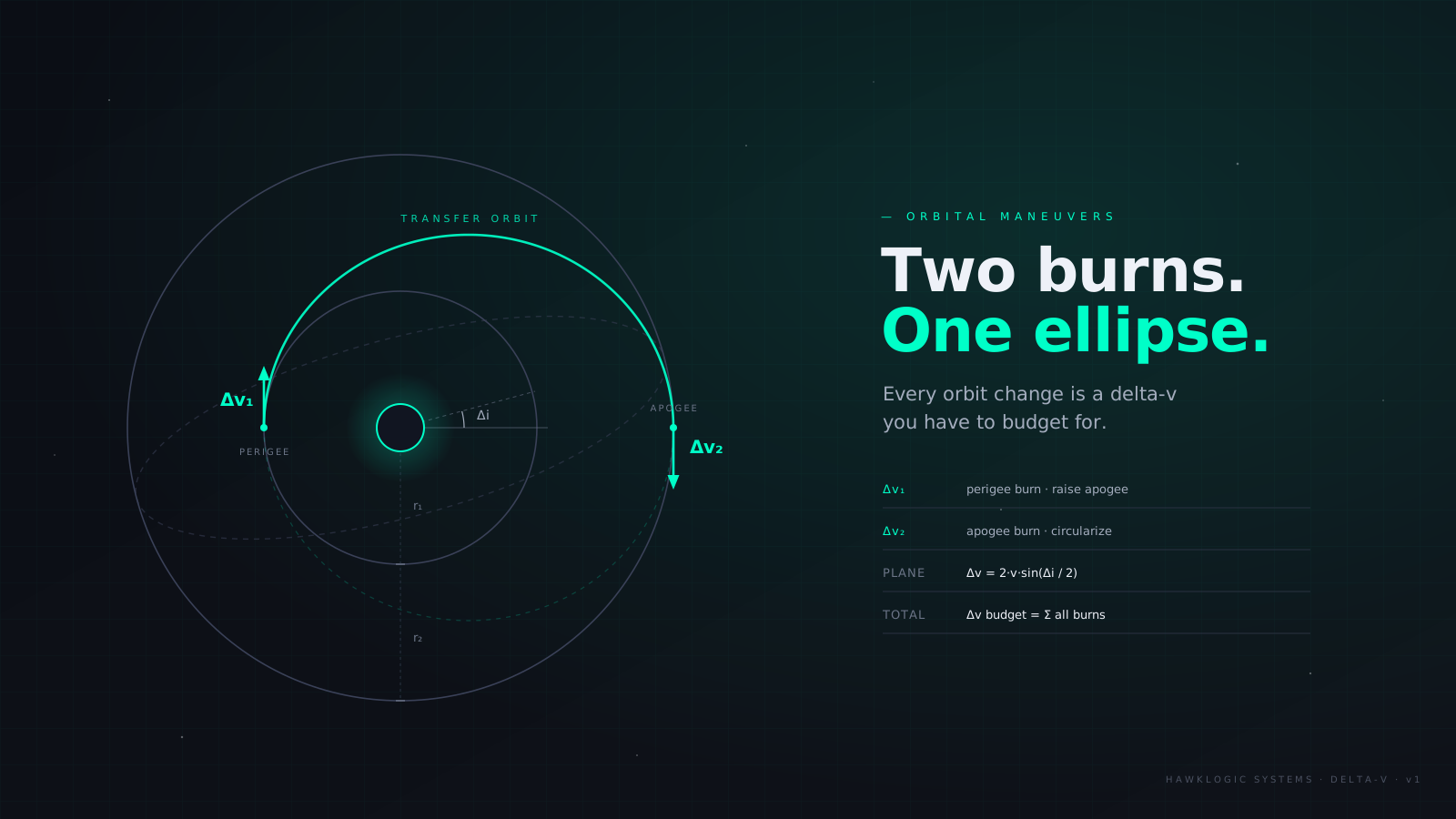
Every maneuver a spacecraft will ever perform gets paid for from one account: the delta-v budget. Orbit raising, phasing, collision avoidance, drag make-up, disposal. The currency is velocity change, and the exchange rate into propellant mass is brutally exponential. This post derives the two workhorse results (the Hohmann transfer and the rocket equation) from first principles, works a real 400 → 700 km example, and covers the plane-change trap that dominates budgets people get wrong.
The arithmetic below is what our delta-v calculator runs; the propellant conversion at the end is propulsion-sizing.
Vis-viva, the only equation you need
Conservation of energy for a body in a Keplerian orbit gives the vis-viva relation:
v² = μ · (2/r − 1/a)where μ = 398,600.44 km³/s² for Earth, r is the current radius, and a is the semi-major axis. Two immediate special cases: a circular orbit (r = a) has v = √(μ/r), and any ellipse has its fastest point at perigee and slowest at apogee. Everything in this post is repeated application of vis-viva at different points on different conics.
The Hohmann transfer: two burns, minimum energy
To move between two coplanar circular orbits of radii r1 and r2, the Hohmann transfer uses an ellipse tangent to both: perigee at r1, apogee at r2, so its semi-major axis is at = (r1 + r2)/2. Tangency is the point. Because each burn happens where the transfer ellipse is parallel to the circular orbit velocity, every m/s of burn goes into changing speed, none into changing direction. That’s what makes it the minimum-energy two-impulse solution for moderate radius ratios.
Burn 1 (at r1): accelerate from circular speed onto the transfer ellipse.
Δv1 = √(μ/r1) · (√(2·r2/(r1 + r2)) − 1)Burn 2 (at r2, half an orbit later): the spacecraft arrives at apogee moving slower than circular speed. Accelerate again to circularise.
Δv2 = √(μ/r2) · (1 − √(2·r1/(r1 + r2)))Both burns are prograde for a raise. The transfer takes half the period of the ellipse, t = π·√(at³/μ).
Worked example: 400 km to 700 km
A common real case: deploy from an International Space Station-adjacent rideshare at 400 km, operate at 700 km. Radii: r1 = 6778.14 km, r2 = 7078.14 km, at = 6928.14 km.
Circular and transfer-ellipse speeds from vis-viva:
v_c1 = √(μ/r1)                    = 7.6686 km/s   (circular, 400 km)
v_c2 = √(μ/r2)                    = 7.5043 km/s   (circular, 700 km)
v_p  = √(μ·(2/r1 − 1/at))         = 7.7511 km/s   (transfer perigee)
v_a = √(μ·(2/r2 − 1/at)) = 7.4226 km/s (transfer apogee)| Burn | Computation | Δv |
|---|---|---|
| 1 (raise apogee) | 7.7511 − 7.6686 | 82.6 m/s |
| 2 (circularise) | 7.5043 − 7.4226 | 81.7 m/s |
| Total | 164.3 m/s |
Transfer time: π·√(6928.14³/μ) = 2869 s, about 48 minutes. Run the same case in the Hohmann transfer calculator, using the 12 kg wet mass and 220 s specific impulse from the propellant example below, and try moving the target altitude; the near-linearity of Δv with altitude change in LEO (roughly 0.55 m/s per km of raise here) is worth internalising.
A useful cross-check: for small radius changes, total Hohmann Δv converges to v_c1 − v_c2, the difference of circular speeds. Here that difference is 164.3 m/s, matching the two-burn total to within a tenth of a m/s. This is also exactly the Δv a continuous low-thrust spiral pays for the same transfer, which is why electric propulsion loses nothing on Δv for LEO raising. It pays in time instead: weeks of spiralling versus 48 minutes.
The plane-change formula: Δv = 2·v·sin(Δi/2)
This is the term that quietly eats delta-v budgets. A pure inclination change by angle Δi at speed v is a vector rotation, and the chord of the rotation is the burn:
Δv = 2·v·sin(Δi/2)The sine doesn’t save you, because v is enormous. At 400 km, v = 7.67 km/s, so one degree of inclination change costs 2 × 7668.6 × sin(0.5°) = 133.8 m/s. That single degree costs about 81% of the entire 300 km altitude raise we just computed. Ten degrees costs 1337 m/s, which for most small spacecraft is simply the answer “no”. This is why rideshare inclination is a selection criterion, not a parameter you fix later, and why Sun-synchronous injections that miss the target Local Time of Ascending Node get corrected via nodal drift over months rather than burned out directly.
Two standard mitigations:
- Do it slow. Speed is lowest at apogee, so plane changes belong at the highest point available. Geostationary transfer insertions exploit this by doing most of the inclination removal at GEO radius, where v is 1.6 km/s instead of 7.7.
- Do it combined. If a maneuver needs both a speed change and a plane change, one diagonal burn beats two orthogonal-ish ones by the triangle inequality.
Combined maneuver, worked
For a burn that changes speed from v1 to v2 while rotating the plane by Δi, the law of cosines gives:
Δv = √(v1² + v2² − 2·v1·v2·cos Δi)Suppose our 400 → 700 km transfer also has to remove a 1° inclination error. Fold it into burn 2, where the spacecraft is slowest: v1 = 7422.6 m/s (arrival at transfer apogee), v2 = 7504.3 m/s (circular at 700 km, rotated 1°).
Δv2′ = √(7422.6² + 7504.3² − 2 · 7422.6 · 7504.3 · cos 1°) = 153.3 m/sCompare the sequential alternative: circularise (81.7 m/s), then a separate 1° plane change at 700 km (2 × 7504.3 × sin 0.5° = 131.0 m/s), totalling 212.7 m/s. The combined burn saves about 59 m/s, more than a third of the whole transfer cost. Combining is not optional finesse; it’s how budgets close.
From Δv to propellant: Tsiolkovsky
Δv is the physics; propellant mass is the invoice. The rocket equation, from momentum conservation over continuous mass ejection:
Δv = Isp · g0 · ln(m0/mf)where Isp is specific impulse (thrust seconds per unit propellant weight), g0 = 9.80665 m/s², m0 is wet mass and mf dry. Inverted for propellant fraction:
mp/m0 = 1 − exp(−Δv / (Isp · g0))For our 164.3 m/s budget on a 12 kg spacecraft (wet), across three realistic propulsion classes:
| Propulsion | Isp | Exhaust velocity | Propellant | Fraction of wet mass |
|---|---|---|---|---|
| Cold gas (butane) | 60 s | 588 m/s | 2.92 kg | 24.4% |
| Green monoprop | 220 s | 2158 m/s | 0.88 kg | 7.3% |
| Electric (Hall/ion class) | 1200 s | 11,770 m/s | 0.17 kg | 1.4% |
The exponential is forgiving at small Δv/(Isp·g0) ratios and merciless at large ones. Cold gas spends a quarter of the spacecraft on a 300 km raise; add the 1° plane change and a disposal burn and the architecture stops working entirely. This is the table that decides propulsion procurement, and it’s why the trade is never “which thruster is best” but “which exhaust velocity does my total budget require”. Propulsion-sizing runs this conversion with tank fraction, thrust level, and burn-time constraints included.
Assembling the budget
A real delta-v budget for a LEO mission stacks entries like these, each carrying margin:
- Injection error correction: 5–20 m/s, depends on launch vehicle dispersion
- Orbit raise/transfer: from the Hohmann arithmetic above
- Plane/LTAN correction: from 2·v·sin(Δi/2), or months of patience
- Drag make-up: altitude- and solar-cycle-dependent, from a decay model
- Collision avoidance allocation: operator-dependent, commonly 2–5 m/s/yr
- End-of-life disposal: often the largest single entry at higher altitudes
Then apply the rocket equation to the total, not to each line, because propellant for later burns is mass carried through earlier ones. Standard practice adds 5–10% Δv margin before sizing tanks, plus residuals and pressurant that never count as usable.
Impulsive-burn assumptions hold when burn duration is short against the orbit period; long burns from low-thrust systems suffer gravity losses that the equations above don’t capture, and finite-burn corrections or a spiral model take over. For LEO work with chemical thrusters, the two equations in this post plus honest bookkeeping get you a budget that survives review.
On this page
Read next
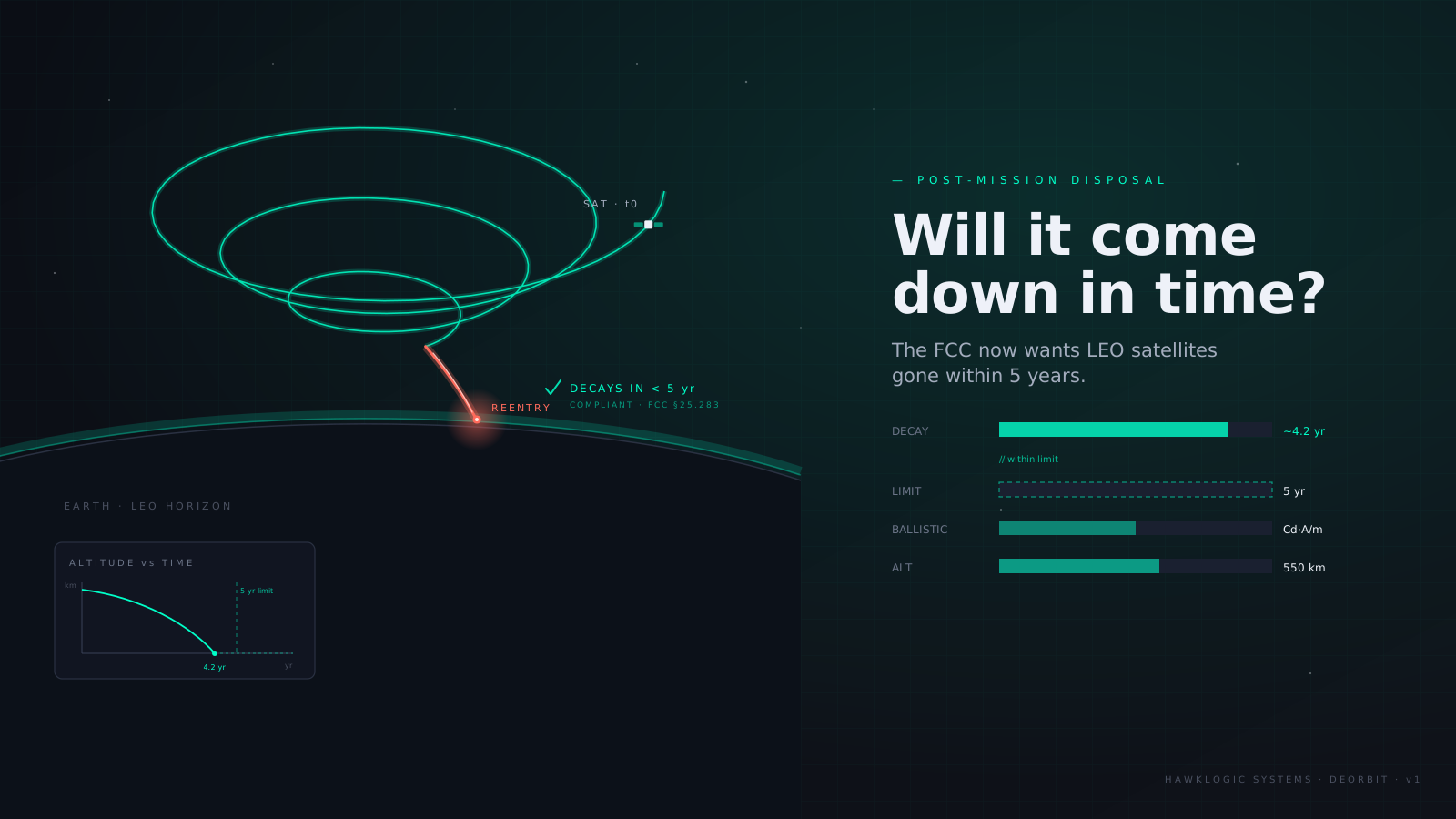
The FCC 5-year rule: will your CubeSat come down in time?
Orbital decay physics, ballistic coefficient, solar-cycle sensitivity, the FCC 5-year post-mission disposal rule, ESA Zero Debris, and remediation options.
8 min read
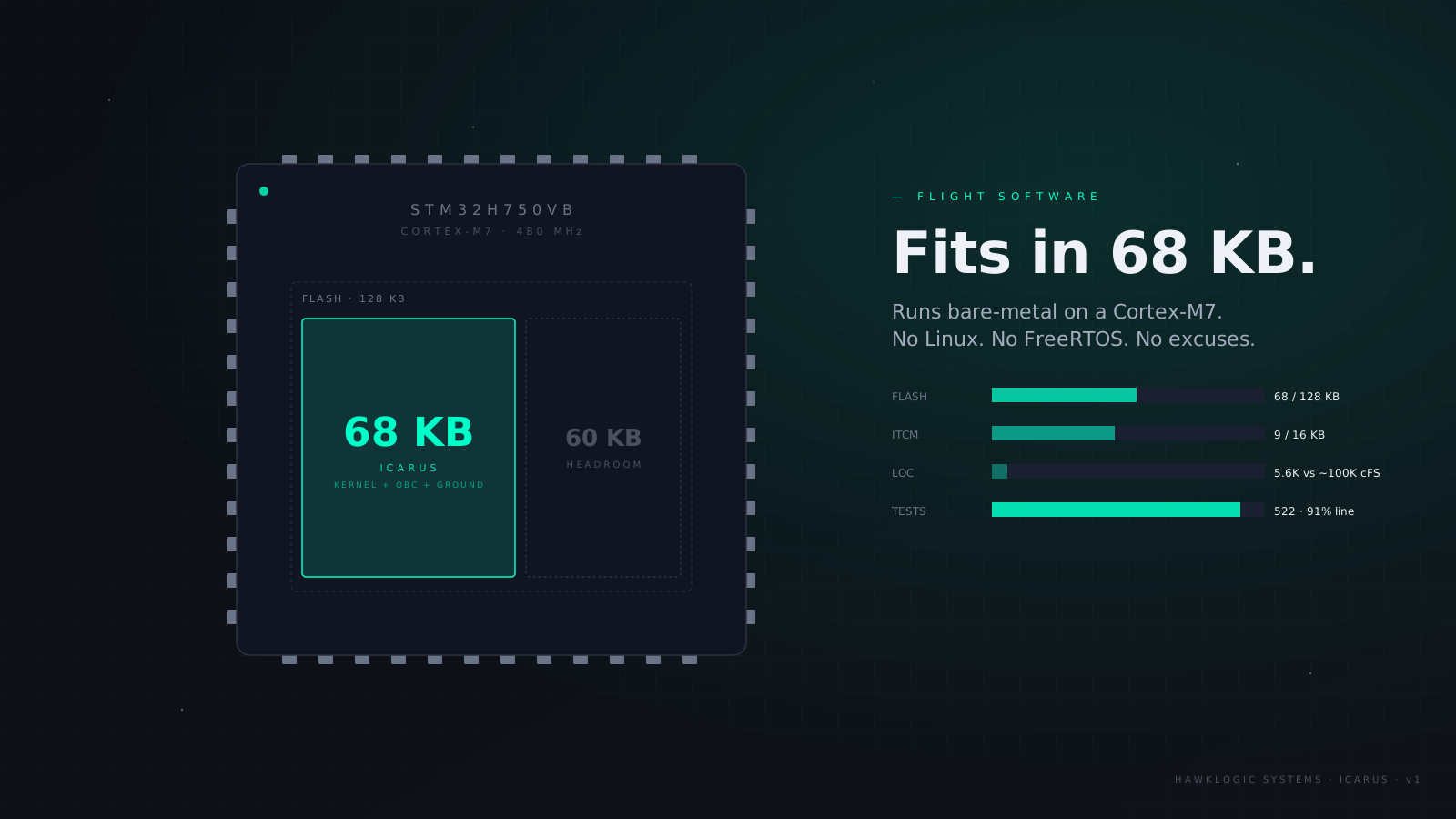
How we fit a satellite flight computer in 68 KB of flash
ICARUS, our satellite OBC platform, runs the full stack (kernel + OBC app + ground-link protocols) in 68 KB of flash on a Cortex-M7. No Linux. No FreeRTOS. Here's why, and what it cost us to get here.
8 min read